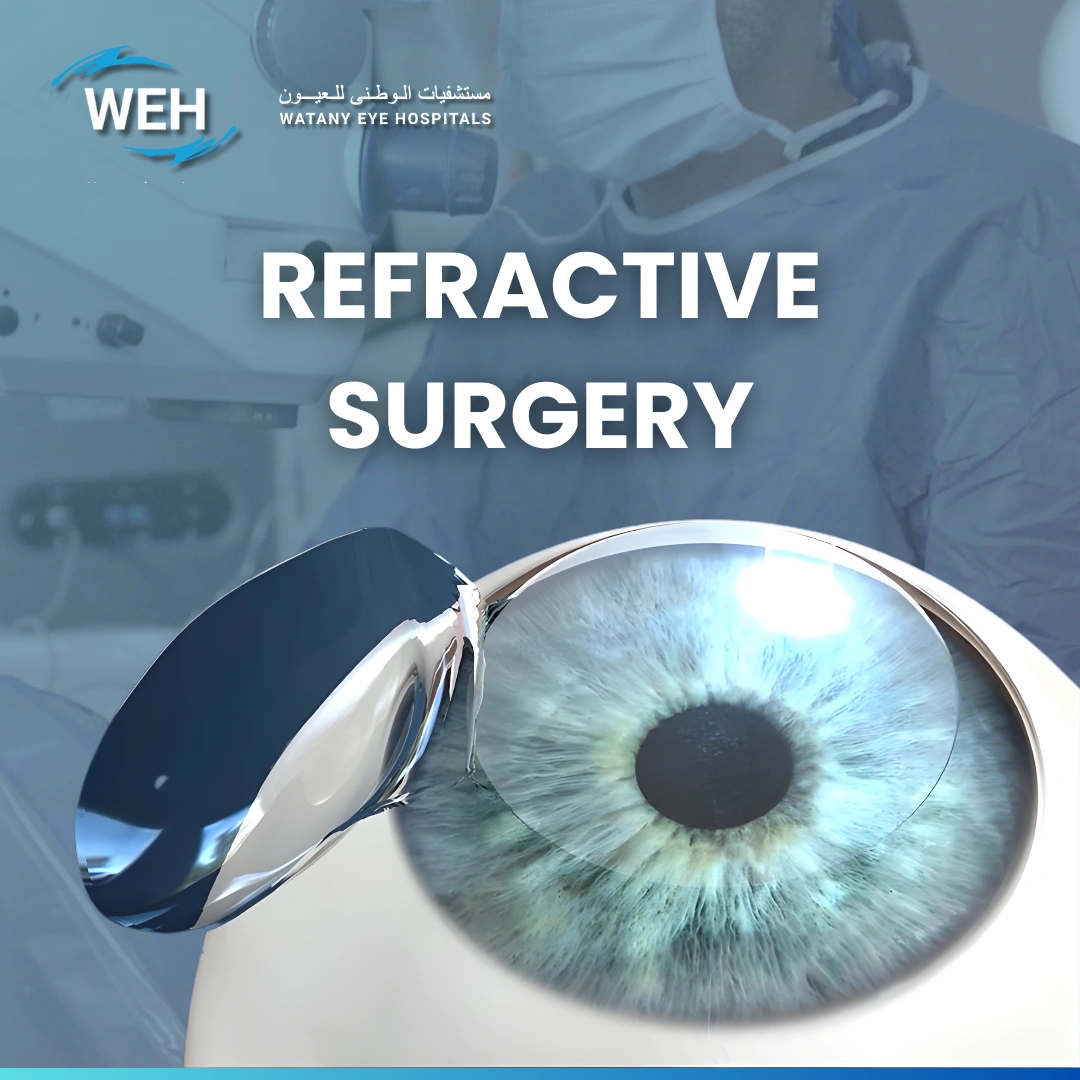
Laser Vision Correction
Your Comprehensive Guide to Clearer Vision Without Glasses or Contact Lenses
Many people experience refractive errors such as nearsightedness (myopia), farsightedness (hyperopia), and astigmatism, which can significantly affect visual quality and daily life.
With major advances in ophthalmology, laser vision correction procedures have become among the safest and most effective options to reduce or eliminate dependence on glasses and contact lenses for suitable candidates.
The primary goal of these procedures is to precisely reshape the cornea, allowing light to focus correctly on the retina, resulting in clearer and more comfortable vision.
Who Is a Suitable Candidate for Laser Vision Correction?
Selecting the right candidate is essential to achieve safe, stable, and satisfactory outcomes. Key eligibility criteria include:
✔ Appropriate Age
Patients are generally advised to be 18 years or older, once refractive error has stabilized.
✔ Stable Vision
Myopia, hyperopia, or astigmatism should be stable for at least 1–2 years prior to surgery.
✔ Overall Eye Health
The eyes should be free from:
-
Chronic eye inflammation
-
Corneal diseases
-
Glaucoma
-
Cataract
-
Retinal disorders
✔ Adequate Corneal Thickness
The cornea must be sufficiently thick to allow safe reshaping.
✔ Good General Health
Candidates should be in good overall health, without uncontrolled systemic conditions that may interfere with healing, such as:
-
Poorly controlled diabetes
-
Autoimmune or connective tissue diseases
Pregnancy and breastfeeding may require postponing the procedure due to temporary vision changes.
Final eligibility is always determined after a comprehensive eye examination and detailed corneal measurements.
Watany Eye Hospitals
Get in touch with our team through hotline or WhatsAppCheck Your Vision Today
Types of Laser Vision Correction Procedures
Several surgical techniques are available to correct refractive errors. The most appropriate option depends on degree of refractive error, corneal thickness and shape, ocular surface condition, and lifestyle needs.
-
LASIK
Used to correct myopia, hyperopia, and astigmatism in suitable patients.
A thin corneal flap is created using a microkeratome, the underlying corneal tissue is reshaped using an excimer laser, and the layer is then repositioned.
-
Femto LASIK
An advanced form of LASIK in which a femtosecond laser is used to create the corneal flap with higher precision without using a microkeratome, improving accuracy and safety.
-
Femto SMILE
A minimally invasive technique in which a small internal corneal lenticule is removed through a tiny incision, without creating a large corneal flap.
Primarily used for myopia and certain cases of astigmatism, based on medical evaluation.
-
PRK (Photorefractive Keratectomy)
A surface laser procedure where the outer corneal layer is removed before reshaping the cornea with laser. Often recommended for patients with thin corneas or when LASIK is not suitable.
-
Trans-PRK
A more advanced surface laser technique in which the corneal surface is removed entirely by laser without surgical instruments. Although healing may take longer than LASIK or SMILE, it can offer improved comfort and precision in selected cases.
Comparing Laser Vision Correction Procedures: Which Option May Be Most Suitable?
Laser vision correction techniques differ, and no single procedure is appropriate for every patient. The most suitable option is determined after careful evaluation of corneal thickness, refractive error, ocular surface health, and lifestyle needs.
LASIK
This procedure may be suitable for patients who have:
-
Adequate corneal thickness
-
No significant dry eye symptoms
-
A desire for rapid visual recovery
-
Mild to moderate refractive errors
Key features:
- Fast recovery
- Noticeable improvement in vision within 24–48 hours
- Short, painless procedure
It may be less suitable for patients who:
-
Have thin corneas
-
Participate in high-impact or contact sports
Femto LASIK
This technique may be considered for patients who:
-
Require a higher level of precision and safety
-
Prefer a fully laser-assisted approach
-
Need more accurate control of corneal layer thickness
Key features:
-
Laser-based creation of the corneal flap
-
Greater precision compared with conventional LASIK
-
Excellent visual stability
Femto SMILE
This option may be appropriate for patients with:
-
Myopia with or without astigmatism
-
Moderately thin corneas
-
Active lifestyles or athletic activities
-
Increased susceptibility to dry eye
Key features:
-
Very small incision without a full corneal flap
-
Less disruption to corneal nerves
-
Lower incidence of postoperative dry eye
Limitations:
-
Not suitable for all refractive errors
PRK (Photorefractive Keratectomy)
This procedure may be appropriate for patients who:
-
Have thin corneas
-
Are not suitable candidates for corneal layer–based procedures
-
Work in professions requiring maximal corneal integrity (e.g., aviation, military)
Key features:
-
No corneal layer creation
-
High safety profile in selected cases
Considerations:
-
Longer visual recovery
-
Temporary postoperative discomfort
-
Gradual improvement in vision
Trans-PRK
This approach may be suitable for patients who:
-
Have thin or sensitive corneas
-
Are not candidates for LASIK or Femto LASIK
-
Prefer a surface procedure performed entirely with laser
Key features:
-
No manual surgical instruments
-
High precision
-
Relatively smoother recovery compared with traditional PRK
Watany Eye Hospitals
Get in touch with our team through hotline or WhatsAppCheck Your Vision Today
Before, During, and After Surgery
Before the Procedure
-
Stop wearing contact lenses as instructed, as they can alter corneal shape
-
Undergo comprehensive eye examinations
-
Inform your doctor about any chronic illnesses or medications
-
Avoid eye makeup before surgery
During the Procedure
-
Performed using topical anesthetic eye drops
-
No pain during surgery
-
Patients are asked to keep the eye steady
-
The procedure takes only a few minutes per eye
After the Procedure
-
Use prescribed eye drops regularly
-
Avoid rubbing the eyes or exposing them to water initially
-
Temporarily avoid swimming, intense exercise, and eye makeup
-
Attend scheduled follow-up visits to ensure proper healing
Benefits of Laser Vision Correction
-
Noticeable improvement in visual clarity
-
Reduced or eliminated dependence on glasses and contact lenses
-
Greater comfort in daily activities such as driving, sports, and travel
-
Long-term visual stability in appropriate candidates
-
Quick, safe procedures with high success rates
-
Improved quality of life and self-confidence
Possible Risks and Side Effects
When laser vision correction is performed following thorough evaluation and appropriate case selection, it is considered a highly safe procedure. Most side effects, if they occur, are temporary and manageable.
Potential side effects may include:
-
Dry eye symptoms, which are more commonly reported after LASIK or Femto LASIK
-
Temporary blurred or fluctuating vision during the early healing period
-
Short-term sensitivity to light
-
A longer visual recovery period with surface laser procedures
-
In rare cases, the need for an additional enhancement procedure to fine-tune vision
How risks can be minimized:
-
Careful and accurate patient evaluation before surgery
-
Strict adherence to postoperative care instructions
-
Regular follow-up visits with the ophthalmologist
Overall, serious complications are uncommon, and most patients experience a smooth recovery with satisfactory visual outcomes.
Frequently Asked Questions
1) Is laser vision correction painful?
No. The procedure is performed under topical anesthesia. Mild discomfort may occur temporarily after surgery.
2) When will vision improve?
Vision often improves within hours to days after LASIK and Femto LASIK. Surface procedures may take longer to stabilize.
3) Are the results permanent?
In most cases, results are long-lasting, provided vision was stable before surgery.
4) Can both eyes be treated on the same day?
Yes, this is commonly and safely done.
5) Who may not be suitable for laser vision correction?
Patients with unstable refractive error, those who are pregnant, or individuals with certain corneal or ocular conditions may not be suitable candidates for laser vision correction at the time of evaluation. In such cases, treatment may need to be postponed or alternative options may be considered based on medical assessment.
6) When can normal activities be resumed?
Light activities can usually be resumed within 1–2 days, while swimming and strenuous exercise should be avoided temporarily.
Medical Advice from Watany Eye Hospitals
For optimal results, laser vision correction should be performed by an experienced ophthalmologist in a fully equipped medical center using advanced technology.
Strict adherence to pre- and postoperative instructions, along with regular follow-up, plays a critical role in achieving safe, stable, and satisfying visual outcomes.
Success Stories and Patient Experiences
At Watany Eye Hospitals, real patient stories highlight the transformative impact of refractive surgeries. These journeys go beyond medical results, they reflect renewed confidence, comfort, and vision clarity.
check our youtube channel for Watany patient testimonials
Watany Eye Hospitals
Get in touch with our team through hotline or WhatsAppCheck Your Vision Today